

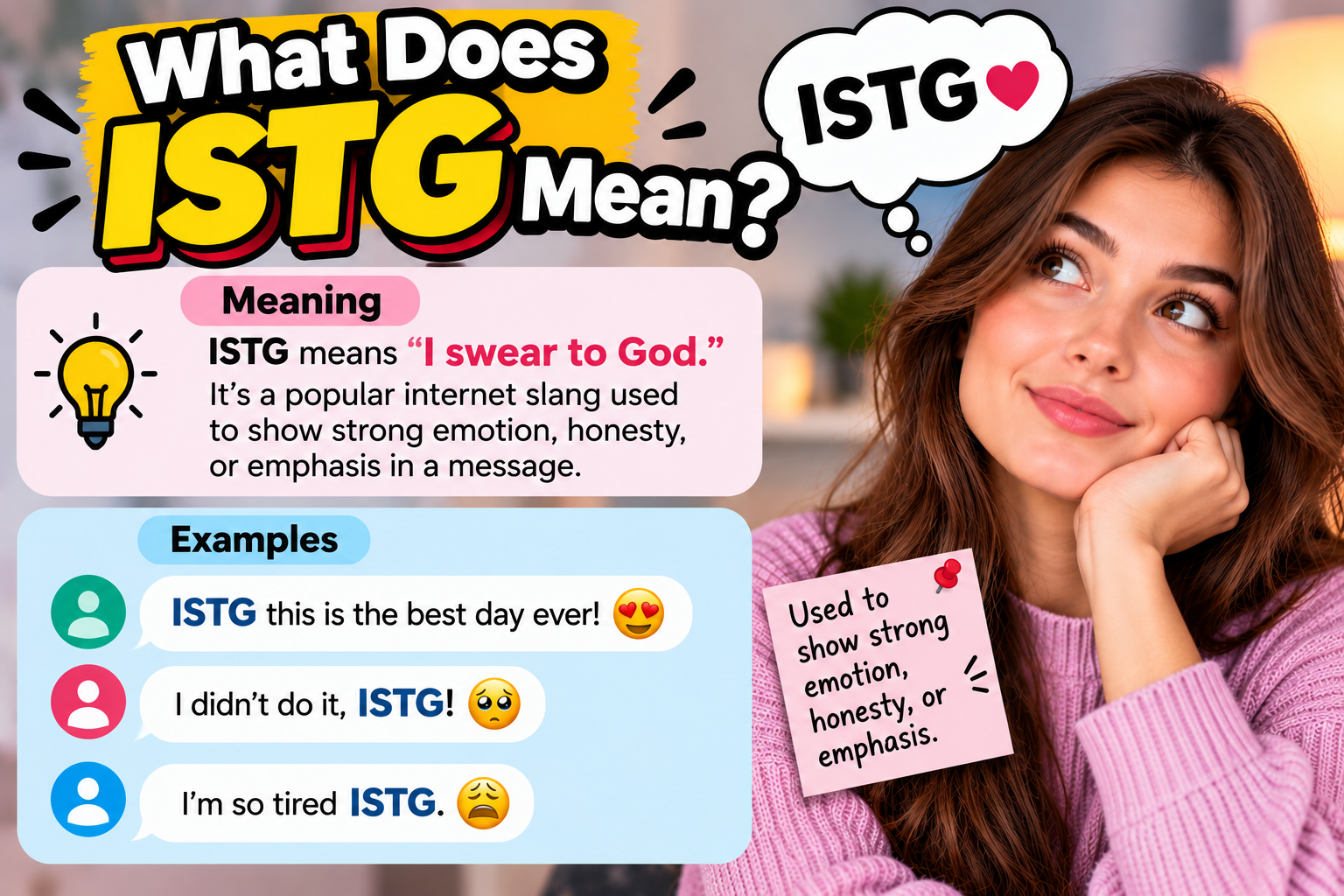
ISTG stands for “I Swear To God.” It is a popular internet acronym used across text messaging, TikTok, Instagram, and X (Twitter) to express strong emphasis, honesty, frustration, or genuine disbelief.
Navigating modern digital slang can feel like cracking an encrypted code. When people search for what does istg mean, they are usually trying to decipher context, tone, and social nuance—because using it incorrectly can completely change the vibe of a conversation. Beyond casual chatting, understanding digital terms like istg meaning in chat helps online creators and modern brand strategists communicate authentically with contemporary audiences.
Here is everything you need to know about ISTG, its cultural origin, and how to use it seamlessly without making things awkward.
ISTG Categorized by Vibe and Tone
The phrase “I Swear To God” takes on different emotional meanings depending on how and where it is written. Understanding these distinct tone categories prevents misinterpretations.
1. The Emphatic & Serious Tone
Used when you need to convince someone you are telling the absolute truth.
- ISTG | Absolute sincerity / Truthfulness | Best for proving a point or assuring someone.
- Srsly | Serious stance | Best for establishing immediate credibility.
- Fr (For Real) | Authentic confirmation | Best for validating a shared fact.
2. The Frustrated or Exasperated Tone
Used when dealing with annoyance, delay, or ridiculous situations.
- ISTG | Simmering annoyance / Loss of patience | Best for venting about bad traffic, tech glitches, or minor inconveniences.
- SMH (Shaking My Head) | Disapproval / Disbelief | Best for expressing mild disappointment.
- Ngl (Not Gonna Lie) | Brutal honesty | Best for delivering uncomfortable truths.
3. The Excited or Hyperbolic Tone
Used when something is extraordinarily good, shocking, or impressive.
- ISTG | High excitement / Exaggerated joy | Best for praising a new album, meal, or movie.
- IJBOL (I Just Burst Out Laughing) | Sudden amusement | Best for reacting to hilarious moments.
- Omg (Oh My God) | Classic shock / Wonder | Best for high-energy reactions.
Linguistic & Naming Psychology Breakdown
Why do acronyms like ISTG take such a tight grip on modern language? The answer lies in semantic speed, phonetic efficiency, and emotional resonance.
- Phonetic Efficiency: “I Swear To God” requires 13 characters and 4 syllables. Replacing it with four quick keystrokes (ISTG) reduces communication friction significantly on mobile keyboards.
- Tone Modulation: Capitalizing the letters (ISTG) signals intense emotion or shouting, while lowercase (istg) suggests a casual, conversational tone or subtle exasperation.
- Cultural Currency: Text slang serves as a social signal. Utilizing modern abbreviations naturally demonstrates digital fluency, which is why lifestyle brands and digital platforms study these semantic shifts closely.
Meaning & Context Comparison Matrix
| Term | Meaning / Vibe | Ideal Context / Usage | Tone Level |
| ISTG | I Swear To God | Expressing extreme sincerity, annoyance, or excitement | High Intensity |
| FR | For Real | Confirming truth or agreement without drama | Medium Intensity |
| NGL | Not Gonna Lie | Preceding a candid or vulnerable opinion | Casual / Soft |
| TBH | To Be Honest | Sharing a straightforward perspective | Casual / Neutral |
| IYKYK | If You Know You Know | Inside jokes or exclusive brand references | Cultural / Niche |
Common Pitfalls When Using ISTG
- Overusing in Professional Contexts: Sending “ISTG” in a formal corporate email or client contract can appear overly casual, un professional, or accidentally aggressive.
- Misinterpreting the Tone: Assuming “ISTG” always signals anger can cause unnecessary misunderstandings when the sender is actually using it for dramatic emphasis or enthusiasm.
- Ignoring All-Caps vs. Lowercase Nuance: ALL-CAPS “ISTG” signals intense anger or high excitement, whereas lowercase “istg” conveys a relaxed, everyday conversational tone.
Strategic Selection Framework: Deciphering Text Slang
When encountering or implementing text acronyms into digital messaging strategies, apply this simple 3-step validation framework:
- Context Assessment: Determine whether the statement expresses annoyance, truthfulness, or excitement based on the surrounding sentence structure.
- Audience Alignment: Ensure the recipient or target demographic resonates with gen-z and millennial chat terminology.
- Tone Calibration: Choose lowercase (
istg) for subtle, conversational flow, or uppercase (ISTG) for heightened dramatic effect.
Frequently Asked Questions
What does ISTG mean in text messages?
In text messages, ISTG stands for “I Swear To God.” It is used to emphasize that the speaker is telling the truth, highly frustrated, or genuinely amazed.
What is the primary ISTG meaning in chat on social media?
The primary ISTG meaning in chat across platforms like Snapchat, TikTok, and Instagram is to add emotional weight to a statement. Users type it when emphasizing their honesty or exaggerating a personal reaction.
Is ISTG considered a rude phrase?
Not inherently. While it contains a reference to swearing, its informal usage is rarely intended to offend. However, it can convey frustration or anger depending on the context of the sentence.
