

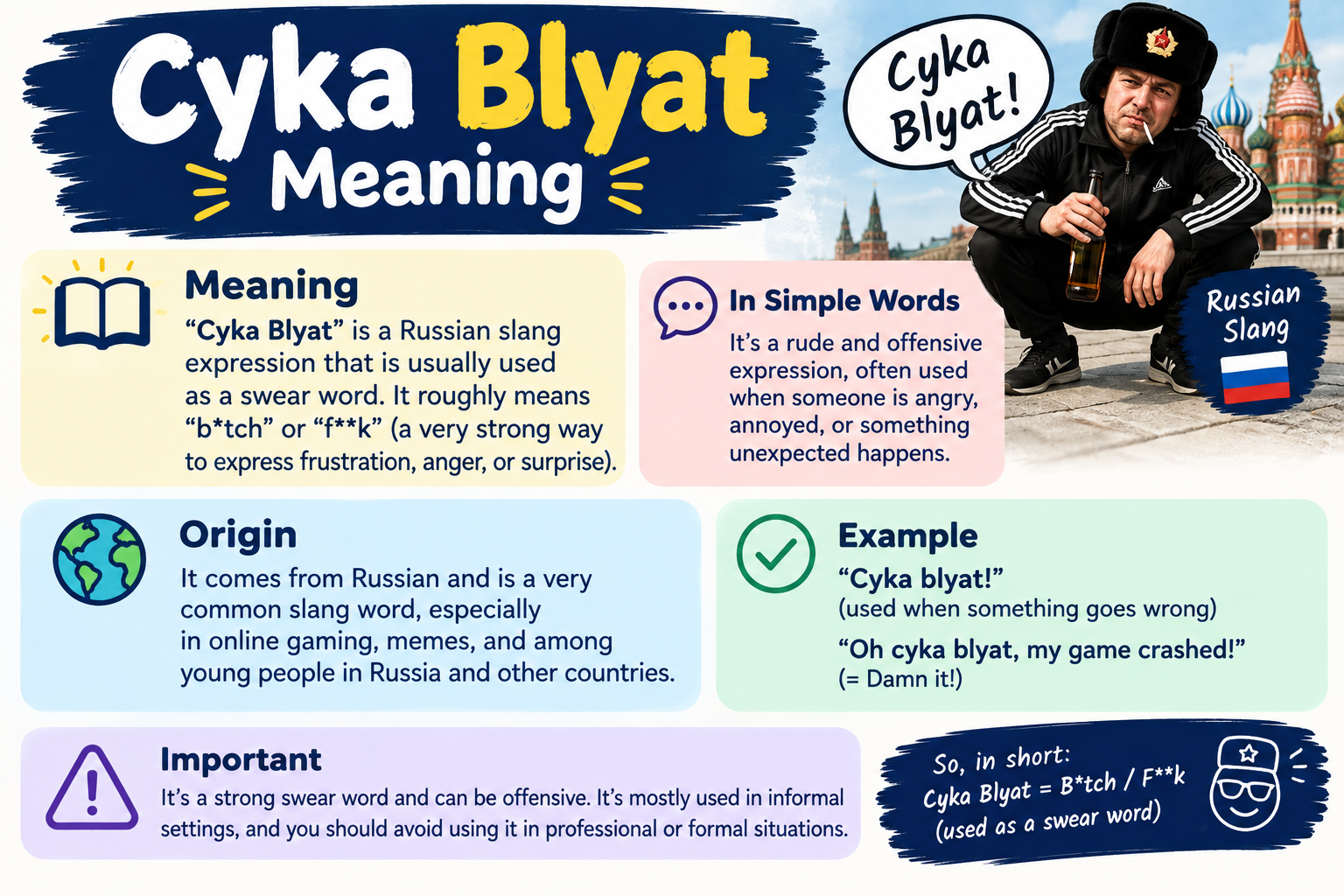
“Cyka blyat” (written in Cyrillic as “сука блядь”) is a high-intensity Russian slang phrase that translates literally to “bitch, whore.” In everyday Russian usage and international internet culture, it functions as an explosive, all-purpose exclamation akin to “fuck!” or “holy shit!”
Most people encounter this phrase through online gaming lobbies, viral memes, or Twitch streams without ever understanding its true linguistic roots or cultural nuances. When building a culturally aware international brand, nav-testing global user bases, or analyzing digital culture, understanding the exact emotional weight and phonetic impact of cross-cultural slang is vital.
Let’s break down the origin, mechanics, and exact usage of this world-famous Russian expression.
What Does Cyka Blyat Actually Mean? Breakdown & Etymology
To understand the full phrase, you need to dissect both words individually. Russian slang (known as Mat) relies heavily on modular profanity, where individual words combine to stack emotional intensity.
1. “Cyka” (Сука)
- Literal Meaning: Female dog (bitch).
- Phonetic Pronunciation: SOO-kah.
- Slang Usage: Used either directly as an insult toward a person or as a general expression of anger, frustration, or annoyance.
2. “Blyat” (Блядь / Блят)
- Literal Meaning: Whore or prostitute.
- Phonetic Pronunciation: BLYAH-ty (with a soft ending).
- Slang Usage: Functions primarily as a comma-like interjection in emotional speech. Russian speakers frequently insert “blyat” into sentences to express shock, emphasis, or disbelief—much like the English word “fuck” or “damn.”
Combined Meaning
When linked together, cyka blyat rarely targets a specific person as a double insult. Instead, it operates as a combined sentence topper—an exclamation of extreme surprise, anger, panic, or victory.
Categorized Contexts: How “Cyka Blyat” Is Used Online
Depending on the environment, the phrase carries completely different vibes and intent. Here is how it breaks down across modern digital culture:
| Context Category | Everyday Vibe / Meaning | Best Characterized By |
|---|---|---|
| CS:GO / Counter-Strike | High-stress tactical command, frustration, or aggressive push. | Gamers yelling during a rushed round on Cache or Dust II. |
| Gopnik / Hardbass Culture | Casual, stylized street-slang identifier associated with Adidas tracksuits and squatting memes. | Satirical YouTube videos, memetic audio tracks, and gaming montages. |
| Casual Russian Slang | Mild to severe expression of annoyance at stubbing a toe or missing a bus. | Spontaneous, non-directed emotional release. |
| Direct Hostility | Aggressive personal insult when directed specifically at an individual. | Heated online arguments or real-world confrontations. |
Linguistic & Naming Psychology Breakdown
Why did cyka blyat become a global viral phenomenon while thousands of other foreign swear words remain obscure? The answer lies in phonetics and linguistic resonance.
Explosive Plosives and Harsh Vowels
The phrase relies on hard plosive consonants (S, K, B, T). In sound symbolism and brand phonetics, harsh plosives immediately trigger alertness in the human brain. The transition from the sharp SOO-kah to the heavy BLYAH-ty creates a rhythmic cadence that is easy to memorize and satisfying to pronounce for non-native speakers.
Memetic Adaptability
In modern internet discourse, words thrive when they are emotionally expressive and easy to type phonetically on standard QWERTY keyboards. Even though the correct Cyrillic spelling is сука блядь, the phonetic Romanization cyka blyat (sometimes stylized as suka blyat) made it effortless to spread across global forums, Reddit, and Twitch chat rooms.
Meaning & Context Matrix
| Expression / Variation | Literal Meaning | Emotional Vibe | Context / Ideal Application |
|---|---|---|---|
| Сука Блядь (Cyka Blyat) | Bitch, Whore | High rage / Peak excitement | Reaction to unexpected loss or huge win in competitive gaming. |
| Сука (Cyka) | Bitch | Targeted annoyance | Directed toward a person or bad luck. |
| Блядь (Blyat) | Whore / Fuck | General emphasis | Used as filler punctuation during emotional storytelling. |
| Rush B, Cyka Blyat | Rush site B (with swearing) | Satirical / Memetic imperative | Originating in CS:GO; used as a comedic call-to-action. |
Common Pitfalls When Navigating Cross-Cultural Slang
Here’s where content creators, international strategists, and gamers often go wrong:
- Overusing It in Real Life: Applying online gaming slang in actual Russian-speaking countries can be perceived as genuinely offensive or uncultured. Mat carries real social taboo outside digital spaces.
- Misattributing Spelling: Confusing standard Latin transliteration (suka) with Cyrillic lookalikes (cyka). In Cyrillic, “c” makes the “s” sound, and “y” makes the “oo” sound.
- Assuming Direct Directed Insult: Misinterpreting an exclamation of frustration as a personal attack during international multiplayer sessions.
- Ignoring Contextual Tone: Failing to realize that tone dictates whether the phrase is lighthearted banter among friends or outright hostility.
Strategic Framework: Decoding Online Slang & Cultural Memes
When evaluating foreign terms or viral internet jargon for media analysis, gaming research, or brand safety, follow this simple 3-step validation framework:
- Isolate the Etymology: Separate literal dictionary translations from modern slang usage to determine baseline severity.
- Identify the Primary Vector: Determine where the phrase gained traction (e.g., Twitch, TikTok, steam forums) to gauge its target audience and memetic life cycle.
- Evaluate Brand & Platform Context: Assess whether the term falls under benign internet banter or high-risk profanity on the platform where you plan to operate.
Frequently Asked Questions
Is “cyka blyat” a bad word in Russian?
Yes. Both words belong to Mat—the strongest category of Russian profanity. It is inappropriate for professional environments, broadcast media, or polite conversation.
Why is “cyka blyat” so popular in gaming?
The phrase gained massive global popularity through Counter-Strike: Global Offensive (CS:GO). Due to shared Eastern European server infrastructure, international players frequently heard Russian teammates use the phrase during intense gameplay, turning it into a gaming meme.
How do you properly pronounce “cyka blyat”?
It is pronounced SOO-kah BLYAH-ty. The “c” in cyka sounds like “s,” the “y” sounds like “oo,” and the “blyat” ends with a soft, palatalized “t.”
The 1-Rule Golden Takeaway
Slang is defined by intent, not just translation—always evaluate cross-cultural expressions through the lens of their active community context rather than literal dictionary definitions.
What Does Cyka Blyat Mean?
If you have seen the phrase “cyka blyat” in online gaming, memes, or social media, you may wonder what does cyka blyat mean. It is a commonly recognized Russian profanity that is often written in Latin letters rather than the Cyrillic alphabet. The expression is generally used to show anger, frustration, surprise, or annoyance, although its exact tone depends on the context. Because it is vulgar language, it may not be appropriate for formal or professional conversations. Understanding the phrase can help readers recognize its meaning when they encounter it in online discussions or gaming communities.
What Does Cyka Blyat in Russian Mean?
If you have come across the phrase “cyka blyat” online, you may wonder what does cyka blyat in Russian mean. It is a commonly recognized Russian profanity, often written in English as “suka blyat.” The expression combines two vulgar words and is generally used to show anger, frustration, surprise, or annoyance. Its exact meaning can vary depending on the situation and tone, so it should not be treated as a polite everyday phrase. Understanding the cultural context behind cyka blyat can help language learners and internet users recognize what the expression means when they encounter it in Russian conversations, gaming communities, memes, or social media.
