

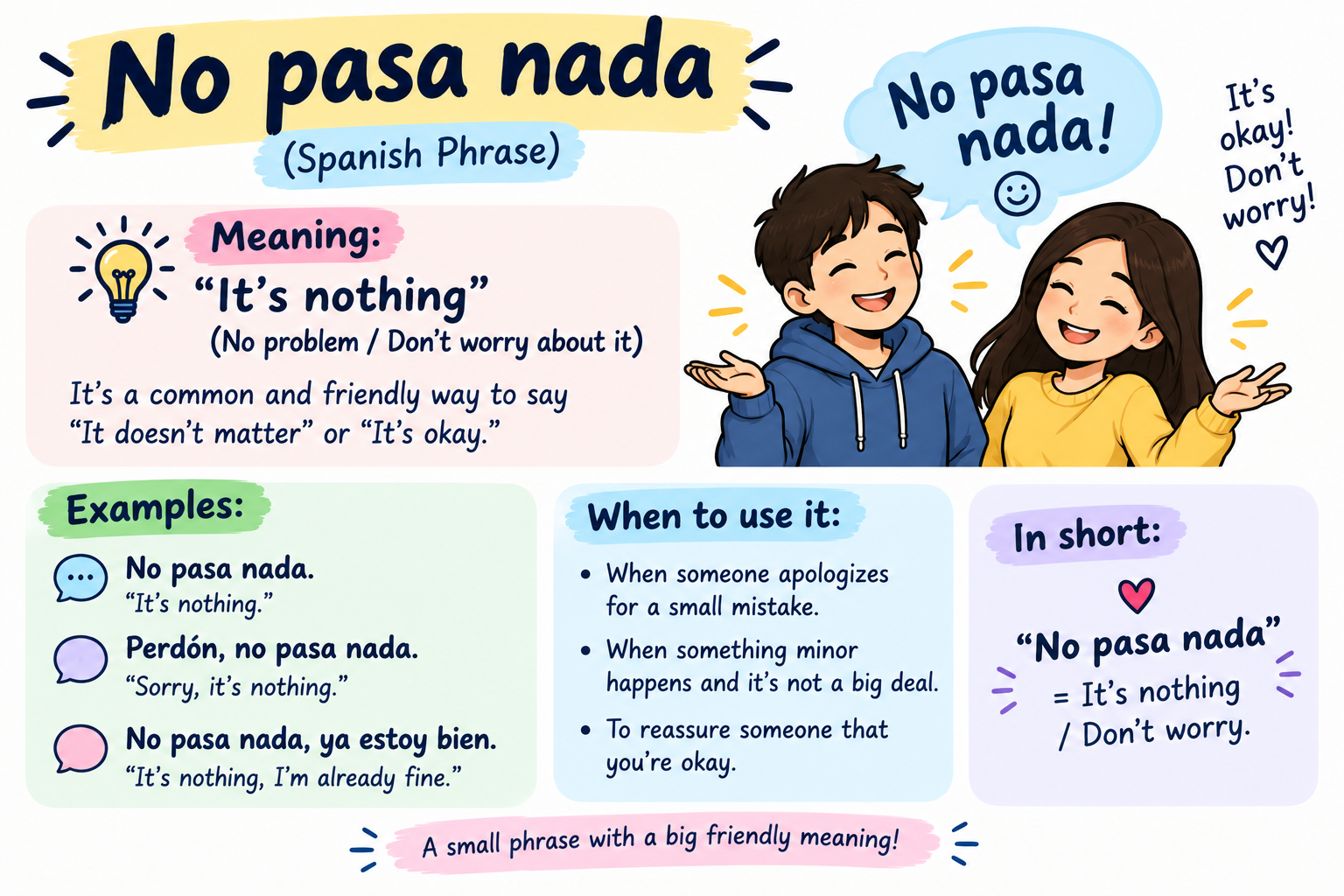
The Spanish phrase “no pasa nada” literally translates to “nothing happens,” but its real cultural meaning is “no worries,” “it’s all good,” or “no harm done.” It serves as an effortless, reassuring response used across Spanish-speaking cultures to defuse minor stress, grant forgiveness, and promote a relaxed, optimistic mindset.
Most name generators fail because they treat phrases as isolated vocabulary words. They overlook the emotional resonance that transforms a simple phrase into an authentic identity, leaving founders with flat options that lack personal context or commercial appeal.
Linguistic & Naming Psychology Breakdown
Phrases like “no pasa nada” resonate deeply because of their open phonetic structure and comforting psychological association.
Phonetic Softness
Open Vowels
A-A-A
Low Resistance
Easy and natural sound flow
High Memorability
Strong sound recall
Cultural Signal
“No Stress” Mindset
Relaxed and effortless association
Trust & Ease
Comfort and familiarity
Lifestyle Magnet
Appealing lifestyle association
Key Emotional Triggers
- Phonetic Cadence: The repetition of soft ‘a’ sounds creates a rhythmic, open acoustic profile that feels natural and non-threatening to say out loud.
- Psychological Safety: At its core, the phrase signals zero friction. In brand positioning, this builds immediate warmth and signals high ease-of-use.
- Versatile Identity: Because it carries both conversational weight and lifestyle appeal, it translates smoothly across consumer goods, hospitality, and modern digital services.
The Meaning Matrix: Variations & Related Phrases
Understanding the nuances of “no pasa nada” alongside related Spanish expressions helps clarify when to use each style for a brand or concept.
| Phrase / Name Idea | Literal Meaning | Emotional Vibe | Best Industry Fit |
|---|---|---|---|
| No Pasa Nada | Nothing happens | Relaxed, forgiving, steady | Casual Apparel, Podcasts, Hospitality |
| Pasa Nada | Happens nothing (Shortened) | Modern, minimalist, punchy | Skincare, Streetwear, BevTech |
| Sin Prisa | Without hurry | Unhurried, deliberate, grounded | Slow Fashion, Specialty Coffee, Wellness |
| Tranquilo | Quiet / Calm | Peaceful, secure, approachable | Mental Health Apps, Travel, Home Goods |
| Pura Vida | Pure life | Optimistic, adventurous, vibrant | Outdoor Gear, Tourism, Activewear |
Categorized Brand Concepts Inspired by “No Pasa Nada”
Here is how the aesthetic behind the “no pasa nada” meaning can be adapted into curated brand identity concepts across different industries:
1. Minimalist & Lifestyle
- Pasa Studio | Unpretentious & Modern | Best for design agencies, capsule wardrobes, architectural studios.
- Nada Lab | Clean Slate & Essentialist | Best for minimalist skincare, sustainable packaging, clean beauty.
- Sin Stress Co. | Direct & Unbothered | Best for functional beverages, stress-relief supplements, ergonomic products.
2. Hospitality & Casual Dining
- Casa Nada | Welcoming & Unwind | Best for boutique stays, coastal Airbnb concepts, rooftop lounges.
- El Tranquilo | Grounded & Laid-back | Best for beachside taco bars, specialty coffee shops, craft breweries.
- Sol & Nada | Warm & Bright | Best for summer resort wear, artisanal spirits, outdoor cafes.
3. Digital & Modern Media
- No Pasa Media | Authentic & Direct | Best for narrative podcasts, lifestyle newsletters, video production.
- Nada Friction | Seamless & Simple | Best for fintech tools, no-code platforms, productivity apps.
Common Pitfalls When Selecting Phrase-Based Names
- Over-complicating Phonetics: Avoid forcing non-native audiences through complex spelling variations. Keep natural spacing intact.
- Ignoring Local Nuance: While “no pasa nada” is universally understood in Spanish-speaking regions, regional slang varies. Always test local context if targeting specific territories.
- Trademark Bottlenecks: Common idiomatic phrases can face higher registration hurdles in broad categories. Ensure you pair the phrase with a distinctive secondary marker (e.g., “No Pasa Nada Clothing Co.”) for registration clarity.
Strategic Selection Framework
To validate whether a phrase-based identity fits your project, follow this four-step test:
- Acoustic Test: Say the name out loud five times in a row. Is there verbal friction, or does it flow naturally?
- Context Fit: Does the emotional promise of “no worries” match the actual experience your customer gets?
- Visual Scalability: Sketch the phrase on a minimalist label or browser favicon. Does it remain clean when shortened?
- Search Clearance: Search exact-match domain availability (
.com,.co) and run initial trademark preliminary screens.
Frequently Asked Questions
Is “no pasa nada” rude or overly casual?
No. While it is informal, it is completely polite and friendly. It is the standard way to tell someone “it’s totally fine” or “don’t worry about it” in everyday conversation.
How does “no pasa nada” differ from “de nada”?
“De nada” specifically translates to “you’re welcome” after someone thanks you. “No pasa nada” is used when someone apologizes or expresses concern about a small mistake or inconvenience.
Can “No Pasa Nada” be trademarked as a brand name?
Phrases in common usage can generally be registered as trademarks if they acquire distinctiveness within a specific industry class and are paired with distinct product framing or logo design.
The Golden Rule of Phrase Naming
A great phrase-based name doesn’t just sound catchier than a generic word—it instantly transfers an existing, positive human emotion straight into your brand experience.
What Does No Pasa Nada Mean?
If you are wondering what does no pasa nada mean, this common Spanish expression generally translates to “nothing is wrong,” “it’s okay,” or “no problem” in English. The phrase is often used to reassure someone after a minor mistake, inconvenience, or unexpected situation. For example, if someone apologizes for being late, another person might say no pasa nada to let them know that everything is fine. The literal meaning is close to “nothing happens,” but its natural English meaning depends on the context. It is a casual and useful expression that you may hear frequently in everyday Spanish conversations.
What Does No Pasa Nada Mean in English?
If you are wondering what does no pasa nada mean in English, the Spanish expression is commonly translated as “it’s okay,” “no problem,” “nothing is wrong,” or “don’t worry about it.” It is frequently used in everyday conversations to reassure someone that a mistake or situation is not serious. For example, if someone apologizes for making a small mistake, saying no pasa nada can communicate that there is no need to worry. Although its literal translation is closer to “nothing happens,” its natural meaning in English depends on the context and tone of the conversation.
